Press to Handstand
- Skill:
- do a press to handstand from the floor
The press to handstand is getting from the floor into a handstand with no kick, no jump, no momentum — you simply lean, your feet leave the ground, and you rise. It's the skill that separates people who can handstand from people who own the handstand.
Almost everyone gets stuck in the same place: the float. You set up, you lean, and your toes stay glued to the floor. So you assume you need more strength, and you go grind more pike push-ups. Usually that's the wrong diagnosis. The float is mostly a balance problem — a stacking problem — and once you see it that way it stops being mysterious.
Prerequisites
- A solid freestanding handstand — you need somewhere to land, and you need to know both sides of balance
- Straight-arm pushing strength from the tuck planche or a straight-arm frog stand
- Overhead pressing strength from elevated pike push-ups
- Pike and straddle compression — you have to be able to fold before you can float
- Healthy wrists that tolerate loaded extension
The float is a seesaw, not a lift
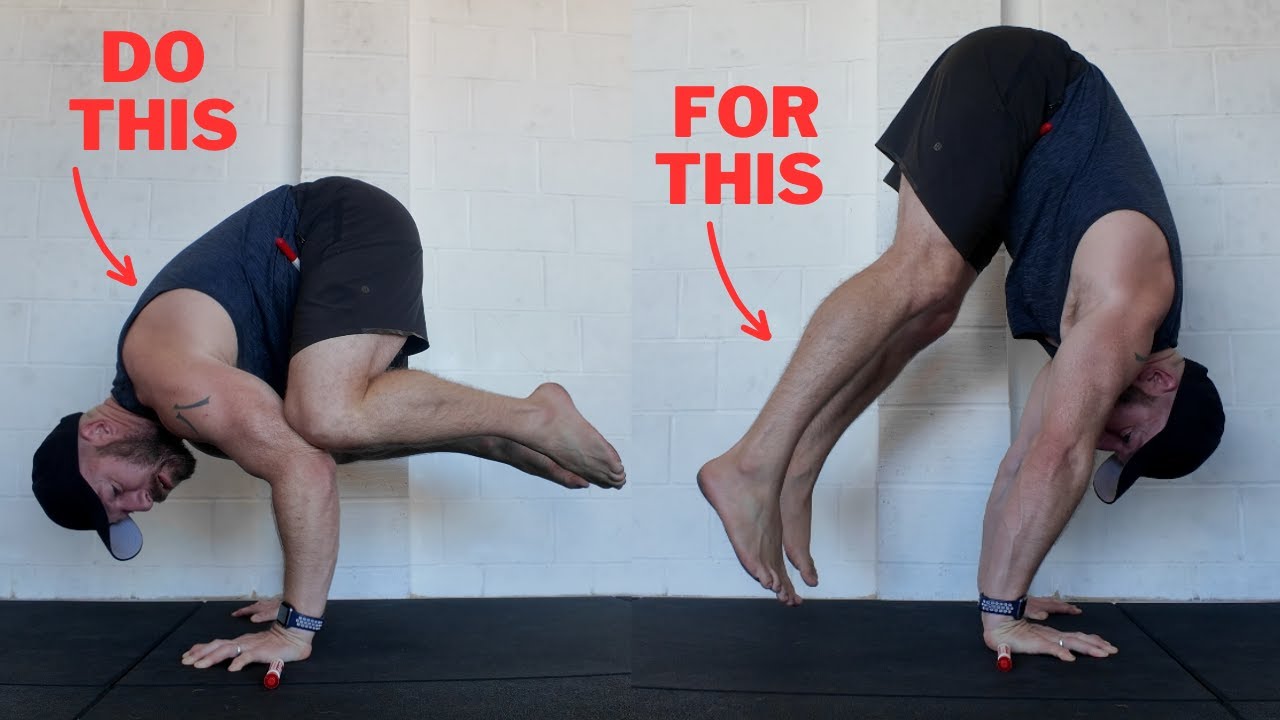
Here's the whole idea, and it's easiest to see in a movement you already have. Get into a frog stand setup with your hands on the floor and put your head on the floor in front of you. Your feet lift immediately — but now your head is stuck. Too much weight in front.
Now push forwards and up with the shoulders and take the hips back. Your head comes up. Somewhere between those two extremes there's a point where your head floats and your toes float — that's the balance point, and it's the same point in every one of these skills.
Your hands are the base. Your hips are the load. Nothing lifts until the hips travel over the base. Try to lift your feet before that happens and you're asking your muscles to do a job that geometry should be doing for you.
Test it yourself with two markers on the floor: put one where your hands go, hold the second one at your hip crease, and just work on bringing the top marker over the bottom one. The moment they line up, the toes float on their own.
This is also why cleaner stacking means less strength required. The fewer body parts sticking out in front of or behind the base, the shorter your levers, and the less work the hold becomes. A straddle press with the hips stacked high is far cheaper than a planche press, where you deliberately drop the shoulders lower and forwards and leave the legs further back — same principle, much more energy.
How to do it

Stand in a straddle, hands on the floor in front of you, fingers spread. From the ground up:
- Hands: your base and your steering wheel. Fingers press to stop the overbalance, palms press to stop the underbalance
- Shoulders: push tall and travel forwards over the hands — this is what moves your weight, not a leg lift
- Back: rounded, not arched. A rounded upper back shortens your torso lever and lets the hips stack higher
- Hips: the thing you're actually moving. Aim them at a point directly above your hands
- Legs: stay compressed and passive at first — they follow, they don't initiate
Lean until the hips arrive over the hands. Let the toes leave the floor by themselves. Only then start lifting the legs, keeping them close to the body, and rise to a stacked handstand. Reverse the exact same path to come down — the negative is where most of the skill gets built.
Watch more here:
Video by Paul Twyman
Common issues
- Trying to lift the legs. The legs are the last thing to move. Move the hips over the hands and the legs come free
- Not leaning enough. By far the most common one. It feels like you're about to fall over — that feeling is the balance point
- Arched back, hips low. An arched back leaves your hips behind the base. Round the upper back and let the hips ride up
- Not enough compression. If you can't fold, your legs hang out behind the base and no amount of leaning will save you. Train pike and straddle compression separately
- No handstand to land in. If you can't hold a handstand, the press has nowhere to end. Build the hold first
- Grinding strength for a balance problem. If your toes won't leave the floor at all, more pike push-ups won't fix it — check where your hips are
Key tips
- Hips over hands. That's the whole float, in three words
- The float shows up in the crow, the pike push-up, the elbow lever and the plche too — practise it in the cheap positions and it transfers
- Do the mobility work so your body can stack, and the strength work so you can hold the position once it does
- Train the negative as seriously as the press — it's the same path, and it's where control comes from
- Progress here is measured in months. Wrists, compression and handstand hold time all have to arrive together