
The elevated pike push-up is the final checkpoint before handstand push-ups. You take the normal pike push-up and raise your feet onto a chair, box, or bench. Because your hips stack more directly over your shoulders, an even bigger fraction of your bodyweight loads the press. This is the closest you can get to a handstand push-up without actually being inverted.
The higher you elevate the feet, the more it approaches a true handstand press. Most people need to work up from a low step to a full-height chair over several weeks. Do this patiently and the wall handstand push-up will feel like a natural next step.
How to do it
Place a sturdy chair, bench, or box behind you. Set up in a high plank and walk your feet back onto the elevated surface. Walk your hands in toward the base of the box so your hips are stacked high, directly over your shoulders, in a tight inverted V. Keep your legs straight. Bend your elbows and lower the top of your head to the floor between your hands. Press back up to full extension.
Watch more here:
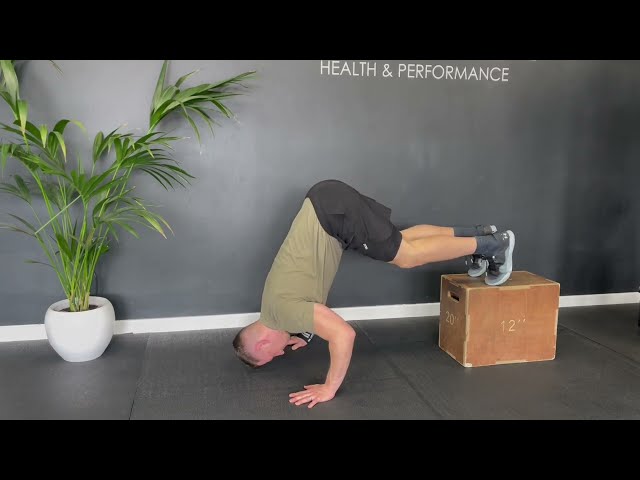
Source: Tom Peto Training · PIKE PUSH UP FEET ELEVATED | Technique Demo
Target
- Sets: 3
- Reps: 10
- Rest: 90 seconds between sets
- Advance when: 3×10 with head lightly touching the floor
Key tips
- The higher the feet, the harder. Start with a low step and raise gradually
- Keep your hips stacked over your shoulders, not behind them
- Head lands between the hands, not in front. This mirrors a handstand push-up
- Core tight, legs straight. Don't let your body fold at the hips mid-rep
- Wedge a pillow or soft mat under your head while you learn the range