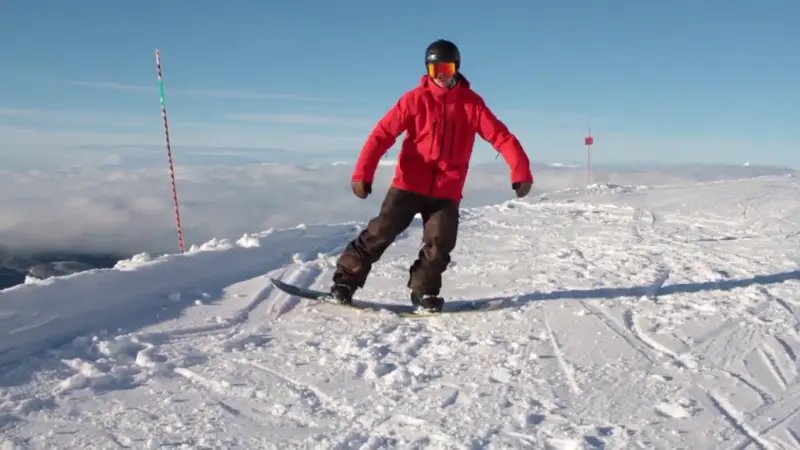
The penguin walk is how snowboarders cross flat ground without unstrapping a foot. On a flat area, hop your weight from your tail to your nose and back again, over and over. On its own this just rocks the board in place - the trick is adding direction.
To go forwards, stack your weight over your toe edge and add a little edge angle as you hop tail to nose. The more edge you create and the more weight you commit to your toes, the more distance you cover per hop. Once that feels easy, try it backwards on your heel edge: stack your weight over your heel edge and lift your toes slightly to create edge angle, then repeat the same back-and-forth hopping motion. Going backwards is noticeably harder and isn't something you'd actually use to get around - it's purely there to build your buttering skills.
Watch your arms while you do this. One arm naturally swings with the opposite end of the board - that's counter-rotation, the same movement you'll use in butters and spins. Exaggerate that swing on purpose and you'll cover more distance with each hop.
Here is a tutorial covering the penguin walk:
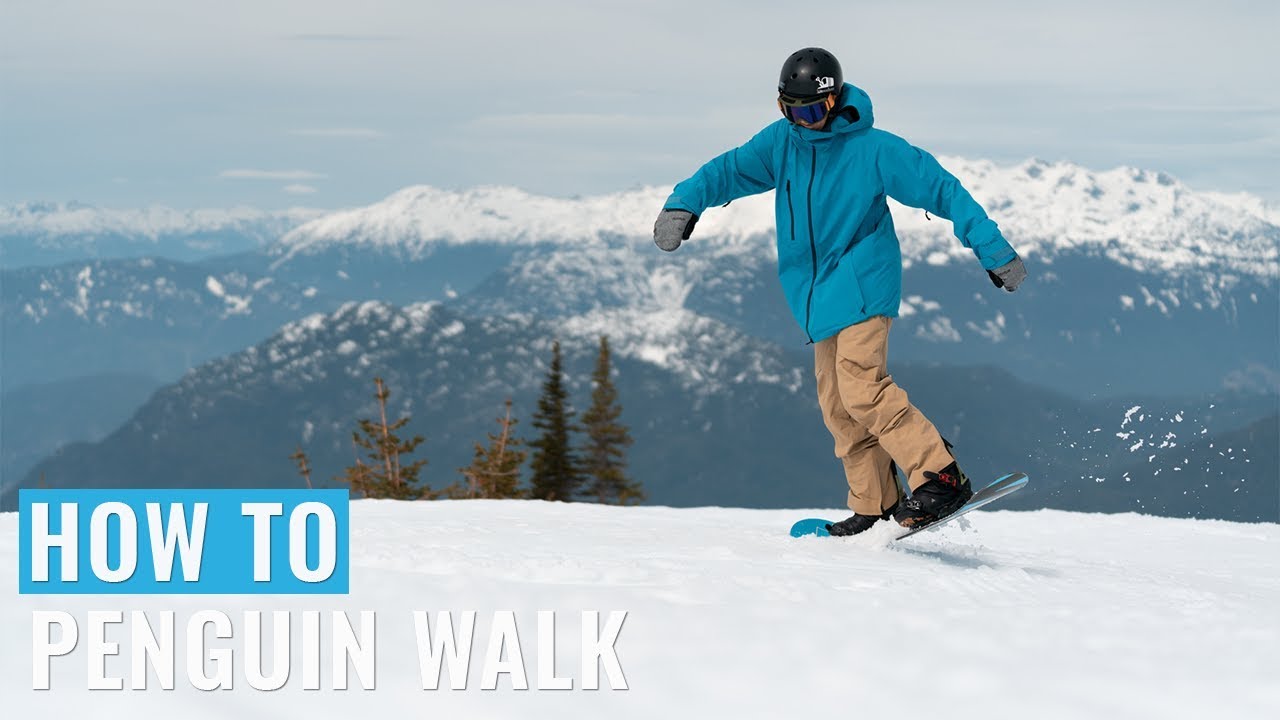
Video by Snowboard Addiction
Key tips
- Practice forwards on your toe edge first - it's far easier than the heel edge version
- More edge angle and more weight committed to that edge means more distance per hop
- The heel edge (backwards) version is significantly harder - don't expect it to feel natural right away
- Exaggerate the counter-rotation swing in your arms to cover more ground each hop
- You can drill this at home on carpet with a training board, no snow required