

This article covers two related skills you'll learn in one session. Sideslip is controlled descent on a single edge with no weight shift, just holding the edge while the board slides straight down the slope. Falling leaf is the same idea but with a weight shift, so the board zigzags down the slope like a leaf falling from a tree. Sideslip is the foundation; falling leaf adds steering on top of it. Mastering both is what makes a steeper slope stop feeling steep.
This builds directly on sliding and stopping: you already know how to set an edge and stop, now you're going to hold that edge while the board moves.
Static sideslip
Start by getting comfortable holding a single edge. The board stays perpendicular to the fall line, your weight stays centered between both feet, and you slide straight down the slope on one edge. No weight shift, no direction change. Just edge control.
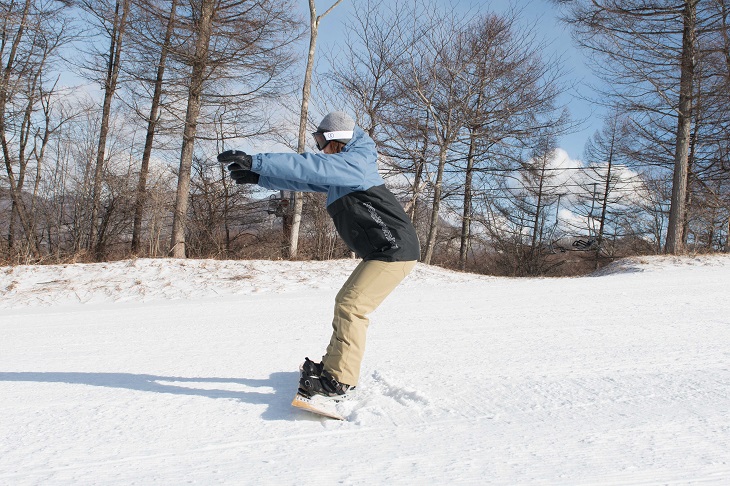
Heelside sideslip. Face downhill on the slope, weight on your heels. Same idea: more heel pressure slows the slide, less heel pressure speeds it up. The mental hurdle here is that you're looking straight down the slope, which feels exposed. Trust the edge - as long as the board stays perpendicular to the fall line, you can't pick up much speed.
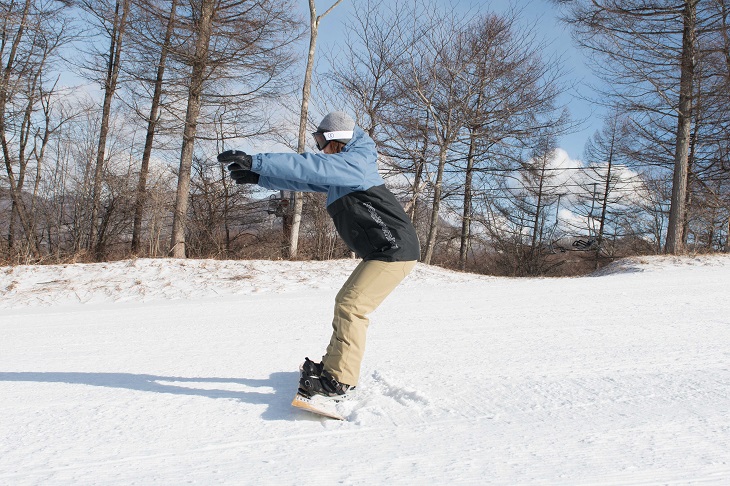
Source: japan-skiguide.com
Toeside sideslip. Most people find heelside easier first because you can see where you're going. Face uphill on a gentle green slope with your weight on the balls of your feet and your shins pressing into the boot tongues. Engage the toe edge and let the board slide. The amount of edge controls your speed: tip more onto your toes to slow down, let the edge flatten slightly to slide faster.
Source: SnowboardProCamp · How To Toe Slide - Beginner Snowboard Lesson
Once you can sideslip down a stretch of green run with your speed under control on both edges, you're ready to add the weight shift.
Falling leaf
Now keep that same edge engaged but start shifting weight between your front and back foot. Shift forward and the board slides diagonally toward the nose; shift back and it slides the other way. Same edge the whole time, no edge change. The board swings back and forth like a leaf falling from a tree.
Toeside falling leaf. Sideslip on your toe edge, then shift weight onto your front foot - the board moves diagonally in that direction. Before it picks up too much speed, shift back onto the rear foot and it slides the other way. Keep the toe edge engaged the entire time.
Heelside falling leaf. Same idea on your heels, facing downhill. Shift forward, slide diagonally; shift back, slide the other way. Stay on the heel edge.
This is the single best drill for getting comfortable on a steeper slope before you commit to full turns. It also teaches you the weight-shift that initiates every turn you'll ever make.
Here is a tutorial on falling leaf:
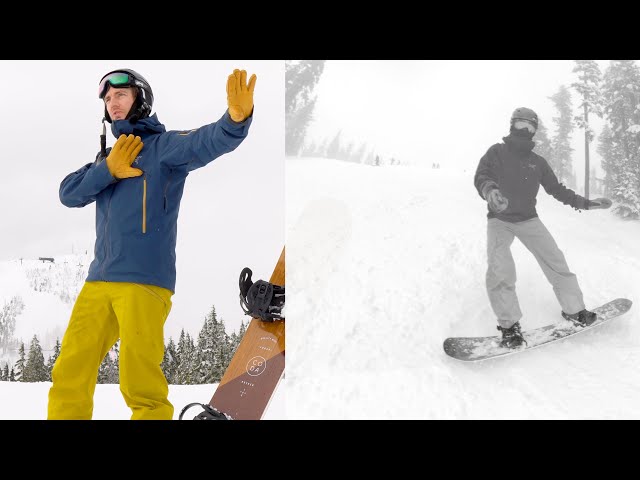
Source: Ryan de Milliano · Side-Slipping Falling Leaf / Zig Zag || Beginner Snowboarding Session
Key tips
- Get sideslip dialled before adding the weight shift; rushing past it makes falling leaf harder than it needs to be
- Keep one edge engaged the entire time. No flat base
- Look in the direction you want to travel; the board follows your head
- Shift weight subtly, not dramatically. A little goes a long way
- Most people find toeside easier first; if heelside isn't clicking, switch sides
- Once you can falling-leaf confidently on both edges, you're ready for garlands