
The dip is one of the most productive upper-body pushing movements in calisthenics. You support yourself between two parallel bars (or the corners of a kitchen counter, two sturdy chairs, or a pair of parallettes), lower your body by bending the elbows, and press back up. Depending on your torso angle, dips load your chest heavily (leaning forward) or your triceps (upright), which is why they work so well alongside push-ups.
Dips are also the second half of the muscle-up. You cannot get a muscle-up without being strong in the dip, and a clean set of 8 full-depth dips is the usual checkpoint before even attempting muscle-up work. Bonus: the same dip bars become the perfect home for future tuck L-sits and L-sit presses.
How to do it
Support yourself on two parallel bars with your arms straight and your body between them. Lean your torso slightly forward and bend your elbows to lower your body until your upper arms are at least parallel to the ground (shoulders at or below elbow height). Keep your elbows from flaring wildly outward. Press back up to full arm lockout.
Learn more here:
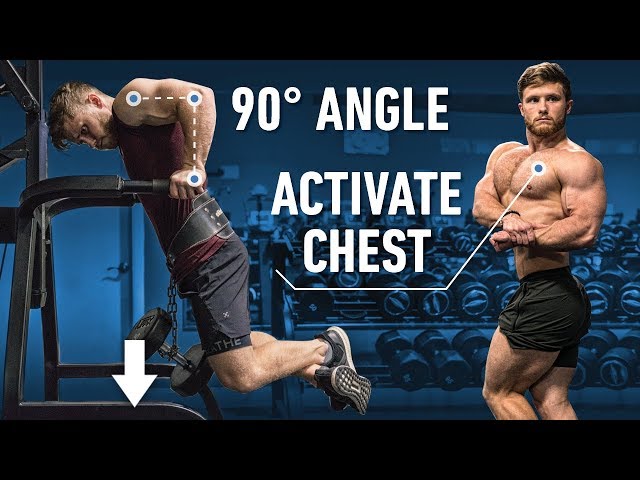
Source: Jeff Nippard · How To Do Dips For A Bigger Chest and Shoulders (Fix Mistakes!)
Target
- Sets: 3
- Reps: 10
- Rest: 90 seconds between sets
- Advance when: 3×10 full depth, shoulders at or below elbow height
Key tips
- Lean slightly forward to emphasize the chest; stay upright to emphasize triceps
- Go deep. Shoulders at or below elbow height
- Keep your elbows tracking back, not flared wide to the sides
- If 8 reps are too hard, do negative dips: jump to the top and lower slowly for 5 seconds
- If your shoulders complain, don't go deeper than you can control