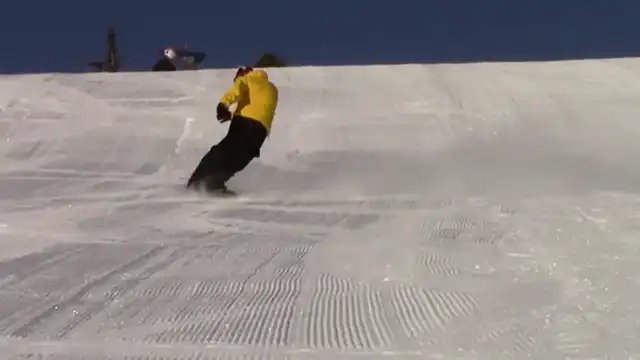
A reverse Eurocarve, sometimes called a revert carve, is a deep laid-out carve where the upper body rotates against the carve direction instead of with it. On a normal heelside Eurocarve your chest faces across the slope and your shoulders coil into the arc. On a reverse Eurocarve, your chest opens uphill, the trailing arm reaches back, and you hold the edge through the turn looking the "wrong way." It's a style move and an edge-control test rolled into one.
Heelside is the standard side to learn it. Initiate the carve normally: edge change at the top, weight forward, ankles and knees rolled into the heelside angle. As the board comes into the fall line and the edge fully engages, deliberately rotate your chest and lead shoulder back uphill, and let your trailing hand reach toward the snow behind you. The hips stay aligned with the board - the rotation is in the torso, not the lower body. Hold that counter-rotated position through the bottom of the arc, then unwind into the next turn. The trick is keeping pressure on the edge with your lower body while your upper body tries to undo the carve. That separation is the whole skill.
Toeside reverse Eurocarves exist but are much harder and less common, because opening the chest away from the slope on toeside fights your natural balance. Get heelside dialed first. Expect to wash out a lot early on - the failure mode is the edge releasing the moment your shoulders pull back. The fix is more lower-body commitment, not less upper-body rotation: drive the knees harder into the hill and trust the sidecut.
More help here:

Video by Ryan Knapton
Key tips
- Don't attempt this until standard Eurocarves are clean and consistent
- Counter-rotate the torso only. Hips stay square to the board
- Initiate the carve fully before adding the upper-body rotation. Adding it too early kills the edge
- Drive harder with knees and ankles to compensate for the counter-rotation
- Wide, firm, low-traffic groomers only. This is not a chop or ice trick
- Heelside first. Toeside reverse Eurocarves are a separate, harder project
- If the edge keeps washing out, your lower body is giving up before your upper body finishes the rotation